
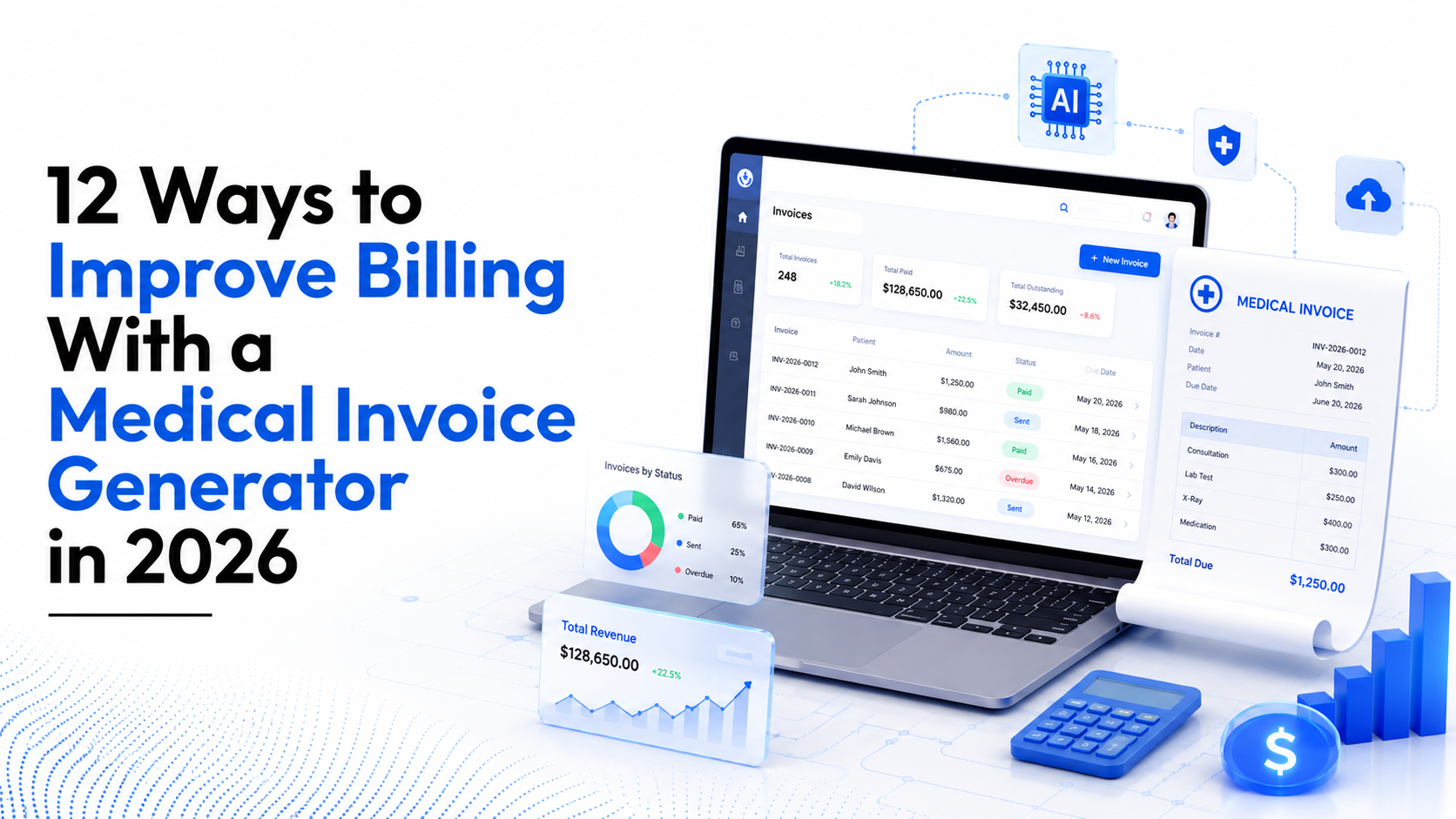
12 Ways To Improve Billing With A Medical Invoice Generator In 2026
Key Takeaways
The medical invoice generator ensures that the billing process is done correctly, speeds it up, and gives clinics a professional and uniform billing system.
Automated tools reduce claim rejections by capturing and verifying patient, procedure, and insurance information before sending an invoice.
Cloud medical billing software enables doctors, clinics, and hospitals to send, monitor, and process an invoice from any device.
Administrative hours are saved weekly with templates created for healthcare — detailed codes, insurance breakdowns, tax fields.
For service-oriented and healthcare-related businesses, some platforms combine invoicing and quotation management, like Casho.ai.
Uploading invoices isn't a quick process, but it's a process that can impact patient trust, cash flow, and the speed of your practice's payment.
Introduction
Billing is a department of healthcare administration that is seldom talked about until it breaks. A missed field, a wrong code, or a delayed invoice can potentially cost a clinic a few weeks of revenue and be a silent killer. If your practice still uses spreadsheets, paper forms, or generic templates, this is not as uncommon as you'd think, as it happens weekly.
A medical invoice generator is the solution. Instead of building a bill from scratch, front-desk personnel and billing teams can use pre-designed templates that mirror the real-life breakdown of healthcare bills—including procedures, insurance split, patient responsibility, taxes, and payment terms—in one place. In the end, there are fewer mistakes made, it gets turned around faster, and the document looks and feels like it was produced in a modern clinic.
It explains how a medical invoice generator can benefit medical billing in 2026, ranging from minimizing claim denials to ensuring patients have a transparent view of their bills. These tips are for a single clinic, billing specialist, hospital department head, or multi-location firm.
1. Format All Invoices In The Same Way
A medical invoice generator will take care to ensure that each bill is equally formatted with patient information, service codes, provider information, and payment terms, thus eliminating the dependence on who types the bill each day. This uniformity is one factor that can minimize the "up-and-down" that takes place when someone in the payer or patient chain of command can't find the necessary information.
Manual billing is prone to drift over time. One staff member adds breakdowns of the taxes; another does not. One invoice includes CPT codes; the other does not include them and writes "consultation" instead. Such minor mistakes lead to patient confusion and delay in the insurance process. Having a generator ensures the consistency of format; regardless of whether the invoice represented a five-minute consultation or a multiple-treatment plan, they were all laid out professionally. This consistency creates trust for patients and payment sources over months, as they know where to find the numbers they need.
2. Cuts Down on Manual Data Entry Errors
The largest area for billing delays is not complicated cases, it's errors. If an invoice is returned for correction due to a transposed policy number, a misspelled patient's name, or a missed decimal point, you add days to the payment cycle. A healthcare invoice generator imports patient and service information into pre-existing fields, saving staff the repetition of typing the same information onto several different forms.
Additionally, many platforms will check the entered values at the point of entry, warning the user of blank required fields or if values appear to be unusual, before sending the invoice. This is more important than it sounds. It has been a consistent finding in studies of medical billing processes that data entry errors at the patient's medical office registration are among the top reasons for claim rejection. If that error rate decreases at the point of the invoice, there will be fewer resubmissions, fewer calls to insurers, and a shorter receivables cycle.
3. Increases The Speed Of Creating Invoices When Customers Have A High Volume Of Work
If your clinic receives dozens of patients each day, manually creating an invoice for each of them isn't feasible. An invoice generator for clinics can quickly produce a detailed, comprehensive bill for the patient by choosing the correct services from a pre-loaded list of services, rather than having to write them all down. The time per patient can be reduced from 15 minutes to 2 or 3 minutes.
This speed compounds. When a billing team receives 40 bills per day, they can spend hours on billing paperwork each week, which could instead be used for pursuing late payments and addressing claims that have been denied. For multi-provider practices, this also means that there's less reliance on any one member of staff who "knows how to do billing" — the structure of the system is established, so any staff member trained can create an accurate bill in a short amount of time.
4. Improves Accuracy in Insurance and Patient Responsibility Splits
The area of medical billing that can be more confusing is being able to identify what insurance will pay for and what the patient will pay for. A medical billing system designed for this purpose automatically calculates these splits, instead of forcing staff to perform calculations every time a visit.
This is important because the split introduces two issues: it bills the patient too much (leading to disputes and refunds), or it bills the patient too little (leading to missing revenue collection later). The automated calculation takes out the guesswork, and many generators allow staff to add on a breakdown of the total, which includes the deductible applied, the coinsurance percentage, and the coinsurance amount. That transparency decreases billing battles and provides a document that can be comprehended by the patient without having to contact the front office to figure out what a line item means.
5. Supports Faster, Clearer Communication With Patients
One of the sneaky causes of delayed patient payments is confusing invoices. If the person doesn't know what they are being charged for, he or she puts the bill aside rather than paying. A medical invoice generator creates an invoice that is itemized and in clear language, enabling patients to understand what they are paying for and why.
Eliminating billing-related calls to the front desk also improves the number of patients that can be seen. Many platforms enable clinics to enter quick notes, payment directions, approved payment options, and when they are due on the invoice. This simple change- the invoice is a communication tool, not simply a financial record- has a quantifiable impact on patient response and payment.
6. Medical Invoice Generator vs. Manual Billing: A Quick Comparison
When you compare manual billing with the automatic generator, you can see that it's better to go for the automatic generator. The table below summarizes the positioning of each approach regarding the most important factors for a clinic's ongoing operations and cost.
This applies to just about any metric: manual billing may be fine in small business, but when volume increases, it simply can't be sustained, and the hidden costs of manual billing (time, resubmissions, delayed payments) can accumulate rapidly. An invoice generator gives you a small initial investment of time to generate a bill with consistent and repeatable accuracy each time.
7. Centralizes Billing Records for Easier Audits
If all the invoices are in spreadsheets, in your email thread, and on paper, then an internal or insurer's audit becomes a climb up the mountain. Having a centralized hospital invoice generator ensures that all hospital invoices, payment status, and any updates to the invoice are stored in a single searchable database so that a single patient's billing history is available within seconds, not hours.
This isn't only helpful in the audit process. Centralized records are more easily analyzed to identify trends: What services are most frequently being billed, what patients have uncollected balances, which invoices are always late. That visibility can help with better financial planning and allows practice managers to see what the clinic's receivables are in real time, rather than wait a month for an educated guess based on scattered paperwork.
8. Minimizes Claim Denials with Built-In Validation
Claim denials can cost more than just money. They can cost you staff hours that are spent determining the issue, fixing it, and resubmitting. Many denials stem from missing modifiers, incorrect medical codes, or patient details that don't align with the invoice or claim. A medical invoice generator with structure identifies these issues before the invoice (and, thus, the claim) ever leaves the building.
Fields were required by built-in validation checks, which also ensure that the formats are the same as those the payer expects, and can point out discrepancies between what is documented and what is being billed. This preventive check will not catch all denials, but it will catch the ones that you can avoid, and research on medical billing efficiency has shown that these are the ones that make up the bulk of medical billing denials. Fewer denials equal a shorter revenue cycle and less billing staff burden.
9. Makes Multi-Location Billing Manageable
A key issue for clinics with multiple locations is ensuring uniformity in billing, even when different front-desk staff, providers, and even tax rules are applied in different regions. A cloud-based invoice generator alleviates this problem by storing the templates and rules at the account level, which means that an invoice created from anywhere is generated according to the same standards, irrespective of who creates the invoice.
This also makes it easier to report. A practice manager can get a view of all billing data from all locations in one place, with no wasted time at the end of the month needing to combine information from up to five different systems or spreadsheets. Manual systems don't scale as businesses grow and expand into 2, 3, or more locations, which is why they're often the first choice for growth for growing healthcare businesses.
10. Faster Turnaround Equals Faster Payments:
A medical invoice generator saves time from service to payment, as it eliminates time-consuming tasks such as manual drafting, formatting, and proofreading of an invoice before it is sent. Automated clinics typically report within days, not hours, of invoicing, significantly speeding up the payment process.
This is an important speed to consider more than you may think. Each day that an invoice goes uncollected is a day that is added to your A/R days. The patient and the insurance company are also likely to pay quickly when the invoice is received just before the date of service, when all the details are fresh. Automating this practice can begin to improve average days-to-payment in the first few cycles just because the invoice is delivered to the payer more quickly and is less likely to include errors that need correcting.
11. Improves Financial Forecasting With Real-Time Data
When billing data is stored in separate files, it's hard to know how much money is coming in and when. A digital invoicing platform keeps real-time records of issued, paid, and unpaid invoices, providing a clinic owner with a real-time view of their cash flow, rather than an estimate compiled at the end of the month.
This visibility enables better decisions, from staffing to equipment purchases to expansion plans—they all rely on an accurate understanding of what revenues to expect and what revenue remains. Real-time dashboards also help track overdue invoices in time, before they become too late. In growing practices, this kind of understanding is what can make the difference between putting in a sound financial plan and constantly running in place to deal with cash flow shocks.
12. Builds Credibility Of The Profession Through Each Invoice
A well-put-together and professional invoice appearance will make it seem organized and reliable — attributes that patients expect when receiving care. Even if the clinical care was great, a generic, handwritten, or inconsistent bill can erode that impression.
A medical invoice generator ensures that all the medical bills or invoices that every patient or insurance provider sees are uniform, have clear formatting, and are professionally produced. It's not just a styling feature. This level of sophistication helps to build trust at each interaction – something manual billing can't even come close to sustaining at scale, particularly for clinics battling for patients in a highly competitive marketplace or hospital departments dealing with external billing relationships.
How Casho.ai Fits Into This
Casho.ai is an online invoicing and quoting solution for clinics, service businesses, and scaling teams that want to produce professional invoices and precise quotes without having to juggle a variety of tools. When it comes to healthcare practices, this will involve itemized billing, insurance breakdowns, and uniform formatting, all within a single dashboard — cutting back on the manual work mentioned throughout this guide and ensuring every invoice looks sharp and professional. When it comes to streamlining the medical billing process while keeping the administrative burden to a minimum, a lot of people will start by combining the medical invoicing with quotation process into a single platform!
Frequently Asked Questions
1. How does a medical invoice generator reduce billing errors?
It employs structured templates and validation rules that alert to any missing or inconsistent data before sending an invoice. This helps prevent common errors such as wrong code, missing insurance information, and incorrect totals, which can result in a delayed payment or claim rejection.
2. What are the concerns of small clinics when it comes to medical invoice generators?
Usually, small clinics experience the most dramatic improvement as they typically don't have their own billing department. A solo practitioner or small team can automate invoice creation to achieve the same level of accuracy and professionalism, without hiring more staff.
3. What is the difference between a healthcare invoice generator and normal invoicing software?
A healthcare-specific tool contains fields and formats customized to medical billing requirements, such as procedure codes, splits of insurance and patient responsibility, and styles that are compliant with the regulations.
4. Is there any benefit to using a medical billing system that increases payment speed for clinics?
Yes. More accurate and quicker invoices are sent to patients and insurance providers, and fewer corrections result in fewer delays in submitting invoices. These help to shorten the average time it takes between service delivery and collection of payment.
5. What should a clinic invoice generator include at a minimum?
It should at least include patient and provider information, broken down services with codes, a breakdown of insurance versus patient, terms of payment, and a due date. Tax fields, payment method options, and branding are optional but helpful features.
6. Do you struggle to get from a manual billing system to an automated invoice generator?
The platforms are usually made to make a negligible transition — existing patient and service information can usually be entered or imported as soon as, and staff normally change within a couple of billing cycles. This learning curve is much less than one spent correcting the ongoing manual mistakes.
7. How does a hospital invoice generator handle multi-department or multi-location billing?
It brings together templates and rules at the account level, meaning that each department or location creates invoices according to the same criteria. This ensures uniformity of formatting and calculations and simplifies reporting throughout the organization.
Conclusion
There is no need to add steps to the clinic's billing process; it is about eliminating the unnecessary ones. The primary reasons for slow payment turnaround are manual errors, inconsistent formatting, and medical invoice errors, which are addressed by a medical invoice generator.
Every improvement adds up to a healthier revenue cycle system, from minimizing claim denials to providing patients with clearer and more professional invoices. Clinics going into 2026 will be much less concerned with chasing after payments and more focused on delivering care to their patients. Thanks to platforms such as Casho.ai, it's attainable, and now you can have both invoicing and quotation management in a single user-friendly and professional tool.